
Reviewed · KYOTO SAKE TOURS
Private Pewter Sake Cup Experience with a Kyoto Artisan
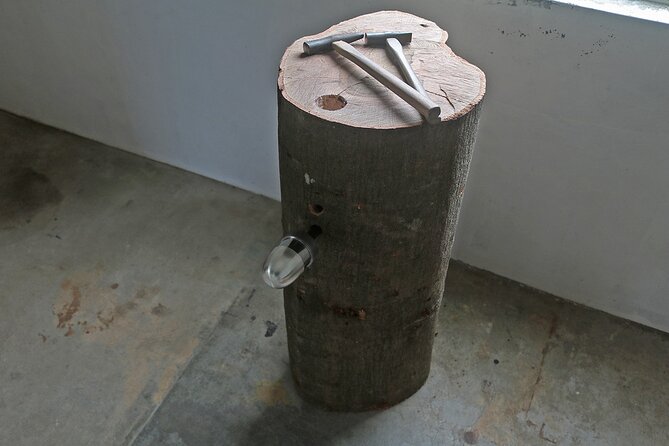
A blank pewter cup, a small anvil, and a choice of hammers are all you need for a memorable Kyoto craft session. Under the calm guidance of Kanako, you shape the metal yourself, rather than simply watching a demonstration. The cup’s final pattern depends on your hammer and your rhythm, so no two pieces come out alike.
I like two things right away: you leave with a useful handmade souvenir, not a fragile trinket, and you can add initials, numbers, or a date to the base. The peaceful setting outside central Kyoto is another plus. The main consideration is the location. Reaching the workshop can take close to an hour by scenic train from Kyoto Station, so this is not a quick activity between major temple visits.
Key points
- Hammer your own design: Choose from several hammers and build the cup’s texture by striking and rotating the pewter.
- Personalize the base: Add letters, initials, numbers, or a meaningful date.
- Work with Kanako: Clear English instruction, patience, and careful help make this suitable for beginners.
- Take home a practical cup: The finished piece measures about 64 mm wide, 53 mm high, and holds about 90 ml.
- Enjoy a quieter side of Kyoto: The workshop is outside the central city, near peaceful mountain scenery and a stream.
- Private setting: Only your own group participates, making this a good choice for couples, families, and friends.
Why this pewter workshop is different
Many Kyoto souvenirs are bought in a shop and packed into your luggage. Here, you make the object first. That changes the value of the purchase. The cup carries the marks of your own decisions, including the pressure of each hammer strike and the pattern you create as you turn the metal.
The activity takes about two and a half hours. That is enough time to learn the process without rushing through it. You are not expected to arrive with craft skills or special equipment. Materials are provided, and the work begins with a prepared pewter cup rather than raw metal.
This is not a lesson in forming a cup from a flat sheet. Instead, you decorate and finish a pewter vessel that is ready to shape with hand tools. That makes the class approachable while still giving you real control over the result.
More Private Sake Bookings in Kyoto:
- Private Tea Ceremony and Sake Tasting in Kyoto Samurai House
★ 5.0 · 163 reviews - Private Sake Tasting in Central Kyoto with Sake Sommelier
★ 5.0 · 32 reviews - Private Food & Sake Tour in Central Kyoto with Sake Sommelier
★ 5.0 · 24 reviews
Meeting Kanako at Craft Gallery SALUK
The workshop takes place at Craft Gallery SALUK, at 35-2 Shizuichinonakacho in Sakyo Ward, Kyoto. The setting is a major part of the experience. This is an out-of-town craft visit, not a shop in the center of Gion or beside a famous temple.
One especially useful detail comes from the practical experience of past participants: the journey can take about an hour by scenic train from Kyoto Station. The route itself may be part of the pleasure, with a quieter setting waiting at the end. One group also received a ride to a more convenient station afterward, cutting the return trip to about 20 minutes, but you should not treat that as a guaranteed service.
Plan this as a half-day outing. Give yourself time to reach the workshop, settle in, make the cup, and return without watching the clock. If your Kyoto schedule is packed with temples and shopping, the distance may feel inconvenient. If you want a slower change of pace, it helps the visit feel more special.
Choosing a hammer and making the first marks
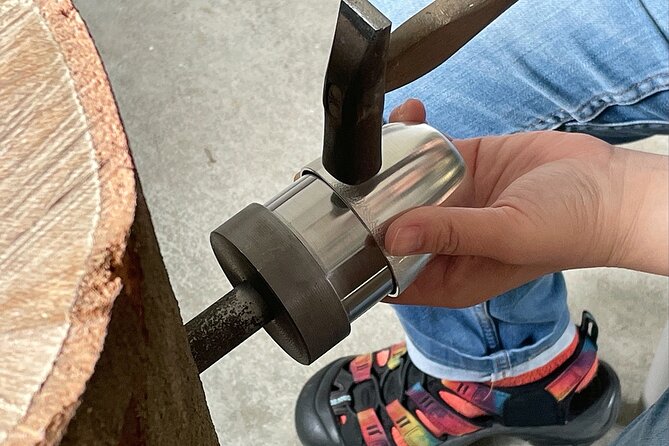
The hands-on work begins with a simple but satisfying choice: selecting a hammer. Several types are available, and each creates a different mark on the pewter. You place the cup on an anvil, strike the surface, rotate the cup, and repeat.
The process rewards patience. A heavy or forceful blow is not automatically better. Your pattern develops from the type of hammer, the angle of each strike, and the spacing between marks. You can use one hammer throughout or combine several for a more varied surface.
This is where beginners may feel uncertain at first. The cup is small, and a few early marks can feel more important than they really are. Kanako’s role is valuable here. She gives clear instructions in English and helps you understand how to proceed without taking the work away from you.
You will probably not produce a perfectly uniform factory finish. That is the point. Slight differences in texture show that the cup was made by hand. You can follow a regular pattern, work more freely, or create a design inspired by something meaningful to you. One unusual example involved a forest-inspired pattern, showing how far you can move beyond a basic repeating texture.
Personalizing the base with letters and dates
Once the outer surface has its pattern, you may add letters, initials, numbers, or a date to the bottom. This is a small feature with a large effect. A name or travel date turns the cup into a record of your time in Japan.
Think about your personalization before the workshop starts. A short set of initials may look cleaner than a long message, and a date can mark a birthday, anniversary, engagement, or family trip. The activity information does not promise unlimited engraving, so keep your idea simple and be ready to follow Kanako’s guidance.
This option is especially useful for couples and families. Each person can create a cup with a related pattern while adding a personal mark. A group can also choose a shared date, creating a set that connects the pieces without making them identical.
More Sake Tours in Kyoto:
- 3-Hour Kyoto Insider Sake Brewery Tour with Tastings & Pairings
★ 5.0 · 917 reviews - Kyoto: Insider Sake Brewery Tour with Sake and Food Pairing
★ 5.0 · 704 reviews - Kyoto Sake Brewery & Tasting Walking Tour
★ 5.0 · 623 reviews - 1.5-Hour Kyoto Insider Sake Experience with 7 Tastings & Pairings
★ 5.0 · 297 reviews
Filing the rim and finishing the drinking edge
After hammering, you use a file to adjust the cup’s height and bevel the rim. This part matters more than it may seem. A drinking vessel should feel comfortable at the mouth, and the rim gives you a chance to help shape that final sensation.
The filing stage is slower and more precise than the hammering. It also gives you a different kind of craft experience. Instead of creating visible decoration, you are refining the cup’s function.
For safety, Kanako completes the final polishing with a rotary machine. That is a sensible division of labor. You do the creative work and some of the hand finishing, while the craftsperson handles the powered equipment and final surface treatment.
The finished cup is about 64 mm in diameter and 53 mm high. It holds roughly 90 ml in normal use, or about 115 ml when filled to the rim. That is a small serving size, well suited to sake, but the cup can also be used for whiskey, chilled green tea, and other drinks.
What makes pewter a meaningful material
The workshop also gives you a chance to understand why pewter has a place in Japanese craft and drinking culture. The metal has a soft, workable character that responds visibly to hammering. Your marks do not disappear into a coating. They become part of the cup’s surface.
One session also connected pewter with flower arranging, with the idea that the material can help keep water clean and flowers fresh longer. Do not book this class solely for that claim, but it adds another perspective on pewter’s usefulness beyond drinkware.
The cup is light enough to handle comfortably and shaped to fit the hand. Its modest capacity encourages smaller servings rather than a large drink. That makes it a pleasant object for a quiet evening at home, especially if you enjoy using things with a story attached to them.
The activity does not require you to drink alcohol. A particularly thoughtful detail is that green tea was provided in place of sake for participants who did not drink. The listing emphasizes the cup-making rather than promising a formal tasting, so regard any drink service as part of the host’s hospitality, not the main product.
The value of a $144.96 private class
At $144.96 per person, this is not a cheap souvenir stop. You are paying for a two-and-a-half-hour private activity, an artisan-led lesson, materials, workshop access, and a finished pewter cup that you made yourself.
The value improves if you care about Japanese craft, hands-on activities, or meaningful objects. A mass-produced cup may cost far less, but it will not carry your hammer marks or a date from your trip. For a couple or family, the private format also gives you time to work at your own pace and share the experience without strangers joining the group.
The price is harder to justify if you mainly want a quick introduction to sake or a short craft demonstration. This experience is about making, not sightseeing. You should also factor in the transport time to Sakyo Ward and the fact that your finished piece is relatively small.
For many people, the strongest value is emotional rather than practical. You leave with something that can sit on a shelf, but it is designed to be used. Later, the cup can bring back the memory of the workshop each time you pour sake, whiskey, or tea.
A private class for couples, families, and small groups
The activity is private, meaning only your group participates. That makes it easier to ask questions, work through a mistake, or take a different design approach. You do not have to match the pace of a large class.
The workshop has suited couples, families, and groups of friends. It also works well for people who already enjoy making things. Past sessions have included woodworkers, textile teachers, photographers, and people studying Japanese crafts. You do not need that background, but an interest in handwork will make the two and a half hours pass quickly.
Kanako’s teaching style is a major part of the experience. She is described as patient, clear, humorous, and generous with her time. English instructions are available, and the setting allows for conversation about Japanese culture and other crafts. The social side can be as memorable as the finished cup.
For families, consider the age and patience of each participant. The activity involves striking metal, filing, and careful handwork. The provided information says most people can participate, but it does not give a minimum age or detailed child policy, so ask before booking if you are bringing young children.
The peaceful setting is part of the payoff
The workshop’s location gives you a break from central Kyoto’s busy sightseeing routes. The surrounding area has been described as calm and mountainous, with a stream nearby. Those details matter because the class is meant to slow you down.
You may find the contrast refreshing after a morning of temples, crowds, and city streets. The quiet setting also fits the work itself. Hammering pewter is repetitive in a good way. Once you understand the technique, you can focus on the sound, the texture, and the gradual change in the cup.
The trade-off is clear: you give up convenience for atmosphere. There is no promise that this will be the easiest workshop to reach from your hotel. Check the route carefully and allow extra time. The experience works best when you treat the journey as part of the outing rather than an unwanted detour.
Packing and practical details
You do not need to bring materials. The workshop provides the pewter cup, hammers, anvil, file, and other supplies needed for the class. Wear something that lets you work comfortably, though the supplied details do not specify a dress code or protective equipment.
Your mobile ticket can be used for the activity, and confirmation is provided when you book. The tour begins and ends at Craft Gallery SALUK. Service animals are allowed, and the meeting point is near public transportation.
The finished cup is small enough to pack more easily than many craft souvenirs. It may be presented carefully for the journey home, with some participants receiving beautifully packaged cups in wooden boxes. Packaging details are not formally guaranteed, so bring enough room in your luggage to protect the piece.
Free cancellation is available if you cancel at least 24 hours before the start time. Cancellations or changes made later are not accepted for a refund. The cut-off follows local Kyoto time.
Who should book this Kyoto craft experience?
I would choose this workshop if you want to make something yourself and are willing to spend much of a half-day outside central Kyoto. It is especially well suited to couples marking a special trip, families looking for a shared activity, and anyone who prefers a personal souvenir to another purchased object.
It is also a strong choice for non-drinkers because the cup can be used for green tea and other beverages, and the host has accommodated participants who do not drink alcohol. You can enjoy the craft without treating sake as the main attraction.
I would think twice if your schedule has no room for the train ride, or if you want a quick, centrally located activity. The class is not designed as a drop-in attraction. Its appeal depends on giving the work time and accepting the journey to the workshop.
Should you book the pewter sake cup experience?
Book it if the idea of hammering your own pattern into a cup sounds better than buying one in a shop. The finished object is compact, useful, and personal, while the private format gives you room to learn without pressure.
The best reasons to go are Kanako’s patient instruction, the chance to add initials or a date, and the quiet setting away from central Kyoto. The main cost is time and transport, not difficulty. Plan for the distance, and this can become one of the most memorable craft activities on your Japan trip.
FAQ
How long does the pewter sake cup experience last?
The activity lasts approximately 2 hours and 30 minutes.
Where does the workshop take place?
It takes place at Craft Gallery SALUK, 35-2 Shizuichinonakacho, Sakyo Ward, Kyoto, Japan. The activity ends back at the same meeting point.
How large is the finished cup?
The cup measures about 64 mm in diameter and 53 mm in height. It holds approximately 90 ml, or about 115 ml when filled to the rim.
Can I personalize the sake cup?
Yes. You can add letters, numbers, initials, or a date to the base of the cup.
Do I need to bring materials?
No. Materials and workshop supplies are provided.
Is the activity private?
Yes. Only your own group participates.
Can I cancel for a full refund?
Yes, if you cancel at least 24 hours before the experience start time. Cancellations or changes made less than 24 hours before the start time are not accepted for a refund.
Newly added around Kyoto
- Kyoto: Fushimi Sake District Tour with Boat Ride★ 4.6 · 10 reviews
- Japanese Sake Breweries Tour in Fushimi Kyoto★ 5.0 · 10 reviews
- Kyoto Sake Brewery Tour with Lunch★ 4.5 · 12 reviews
- KYOTO Sake Tasting Tour at Local Breweries(tasting fee included)★ 5.0 · 16 reviews
- Japanese Sake Breweries Tour in Kyoto Fushimi★ 4.3 · 13 reviews
- Private Nishiki Market Food & Sake Tour by Young Local Guides★ 5.0 · 12 reviews
- Private Sake Tasting in Central Kyoto with Sake Sommelier★ 5.0 · 13 reviews
- Private Food & Sake Tour in Central Kyoto with Sake Sommelier★ 5.0 · 24 reviews
Kyoto Sake Tours, compared.

3-Hour Kyoto Insider Sake Brewery Tour with Tastings & Pairings
Read our review →
Insider Sake Brewery Tour with Sake and Food Pairing
Read our review →
Insider Sake Experience with 7 Tastings and Snacks
Read our review →
Private Tea Ceremony and Sake Tasting in Kyoto Samurai House
Read our review →
Gion Evening Walk with Hidden Gems, Geisha & Sake
Read our review →Browse the lists this tour appears in